Unlock lightning-fast 5G internet almost anywhere

Return to blog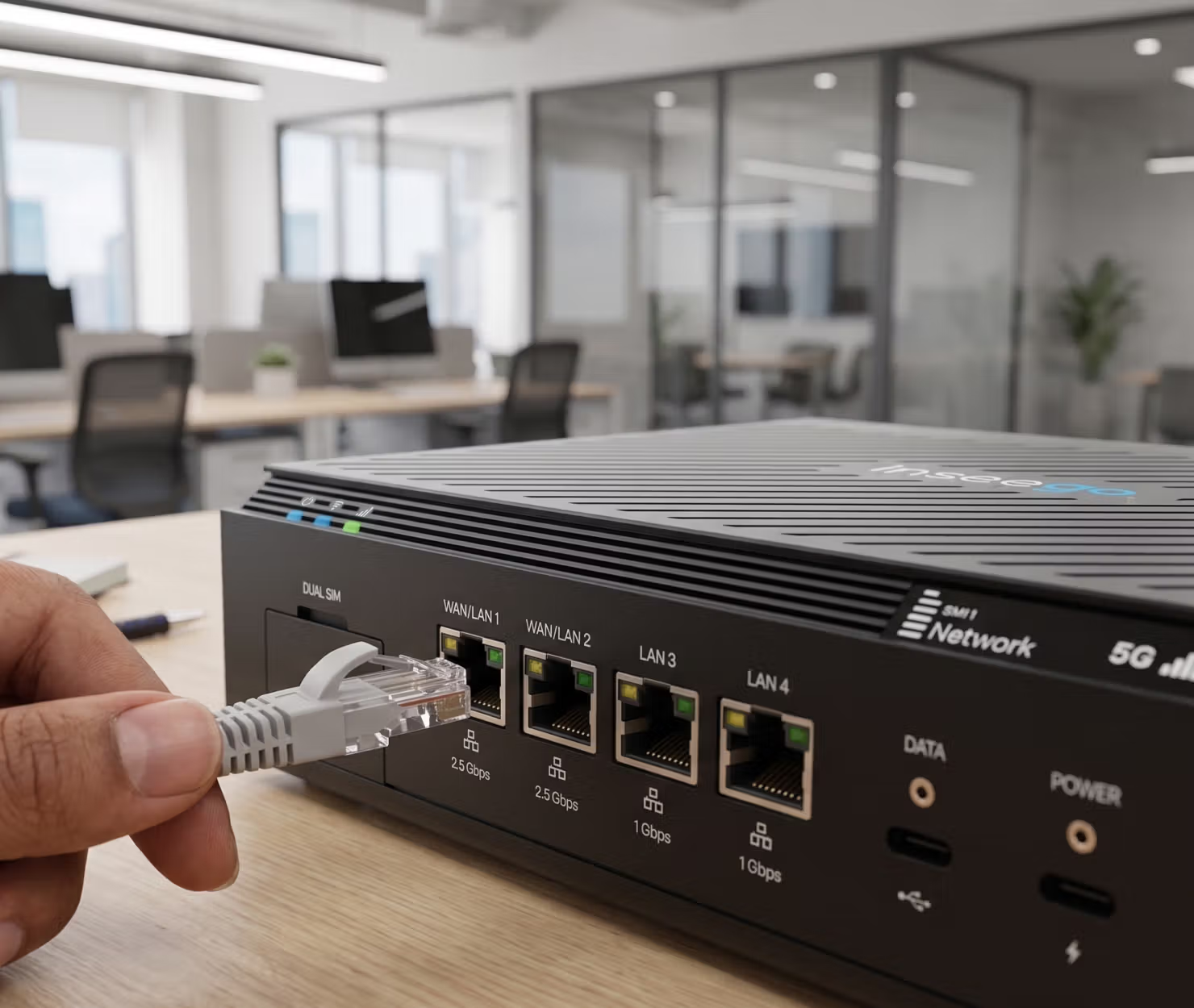
Network Failover
How to choose a 5G cellular failover solution
Updated on October 1, 2026
When a primary wired network fails, it immediately impacts an enterprise's operations. Investing in a cellular backup system is the standard approach to preventing downtime. However, selecting a solution involves looking at more than just basic cellular connectivity.
To ensure continuity for retail locations, distributed branch offices, or complex industrial sites, specific technical capabilities are required. This guide outlines the key features to evaluate when selecting an enterprise failover solution.
1. Multi-path network redundancy: Dual-WAN and Dual-SIM
A reliable backup strategy should avoid introducing new single points of failure. True resilience requires protection at both the local hardware level and the carrier network level.
Wired to wireless network redundancy: Dual-WAN
How it works:
- Physical architecture: The primary wired connection (such as fiber, cable, or DSL) connects directly to the router's WAN 1 port. An enterprise 5G cellular router serves as the standby link on WAN 2 (either natively as an all-in-one branch router like the Inseego FX4200, or via an outdoor 5G CPE like the FW3000 handed off to an existing firewall).
- Active verification: The system does not just wait for a wire to be unplugged. It uses continuous link evaluation (or IP SLA tracking). The hardware constantly sends micro-pings or DNS lookup requests to reliable upstream targets (like Google DNS or Cloudflare) across the primary wire.
- The switch: If the primary wire suffers a physical cut or experiences severe packet degradation (a "zombie connection" where the line is technically plugged in but failing to pass data), the router registers a health check failure. It instantly reroutes the corporate routing table to WAN 2, moving data onto the 5G wireless network.
- Automated failback: While operating on 5G, the router continues running background health checks on the WAN 1 port. Once the primary wired ISP establishes a stable, error-free connection for a set confirmation window (e.g., 5 consecutive minutes), the router automatically shifts traffic back to the primary wire to protect against unnecessary cellular data consumption.
Unlock lightning-fast 5G internet almost anywhere
Wireless network redundancy: Dual-SIM carrier failover
Even if a business transitions successfully to a wireless path, cellular networks themselves remain vulnerable to localized tower outages, network congestion, or regional carrier disruptions. Dual-SIM functionality introduces carrier diversity to protect the backup connection itself.
How it works:
- Carrier splitting: The cellular router features two separate SIM slots (Slot A and Slot B) supporting both physical nano-SIM cards and digital eSIM profiles. Administrators provision these slots with two entirely distinct cellular providers.
- Primary path prioritization: The device designates one carrier (SIM A) as the active wireless path based on localized signal testing and data plan structures. SIM B rests in a passive, hot-standby state.
- Loss of internet detection: If the primary cellular network experiences an outage, severe RF signal degradation, or a core network authentication failure, the router detects that cellular internet traffic has stalled, even though the hardware is still getting power.
- The carrier pivot: The router executes an internal command to drop the connection to Carrier A, switch the internal radio module's profile to Slot B, and authenticate with Carrier B's tower network.
2. Centralized visibility: Cloud-based network management
Managing individual hardware configurations across distributed branches via local, device-by-device interfaces is inefficient for enterprise IT teams. Centralized cloud management provides a single pane of glass to streamline deployments through three key mechanisms:
Zero-Touch Provisioning (ZTP)
- How it works: Devices ship directly to remote sites without needing manual staging at IT headquarters. Once an on-site employee plugs the hardware into power and internet, it connects to the cloud management platform via a secure handshake. The platform identifies the device's unique IMEI or serial number and automatically deploys its pre-assigned network profiles, security rules, and carrier configurations.
Bulk configuration
- How it works: The cloud platform manages the entire fleet as a single, integrated system rather than isolated endpoints. From a central dashboard, administrators can group devices by region or function to push real-time policy updates, modify routing rules, or adjust security credentials globally. This same infrastructure schedules and pushes Firmware-Over-The-Air (FOTA) updates and patches to all targeted devices simultaneously.
Real-time analytics and data cost control
- How it works: Cloud platforms continuously aggregate data telemetry from every active cellular module to prevent unexpected overage fees during extended primary network outages. Administrators use these dashboards to monitor real-time consumption and track billing cycles. They can configure automated rules that trigger alerts at data milestones, throttle non-essential bandwidth during failover events, or enforce strict usage caps across shared data pools.
3. Traffic prioritization and bandwidth management
Running non-essential enterprise traffic over cellular backup can lead to network congestion and high data costs. Business-grade failover solutions use intelligent traffic prioritization to manage resources efficiently while operating on wireless backup.
Quality of Service (QoS) rules
- How it works: The failover router inspects and categorizes incoming and outgoing data packets by application type, source IP, or port. When shifting to a 5G connection, the router applies pre-configured priority rules instantly. This dedicates clear, unthrottled pathways to mission-critical applications like point-of-sale (POS) processing, VoIP lines, and ERP systems, while throttling or blocking high-consumption, low-priority traffic like guest Wi-Fi and video streaming.
Network Slicing
- How it works: Instead of placing the business into a shared public pool of wireless spectrum vulnerable to local tower congestion, the hardware leverages a 5G Standalone (5G SA) core network to access isolated virtual network "slices." The router authenticates with a customized carrier profile that separates the enterprise data plane from consumer traffic. The carrier's network then dynamically allocates a dedicated virtual lane with contractual guaranteed latency, throughput, and speed tiers exclusively for the business's operational data.
4. Proactive operational awareness: Alerts and alarms
If a branch switches to cellular backup, IT teams need immediate notification to address the underlying issue with the primary ISP before data limits are impacted. A robust cloud-management platform utilizes specific, customizable event rules and real-time data telemetry to flag structural or environmental issues across a device fleet before they cause unexpected operational costs:
Cellular/WAN failover trigger
- How it works: A cloud monitoring system continuously tracks the deployed device's active WAN routing interface. The moment the primary wired connection drops and traffic orchestrates over to the cellular path, a cloud system logs a high-priority event. It instantly sends an automated notification to administrators via email, SMS, or an API webhook integrated directly into the enterprise's central network operations console.
Data threshold warnings
- How it works: System administrators set granular, tiered data consumption milestones within a cloud management dashboard (such as 50%, 75%, and 90% of the monthly billing cycle cap). As an edge device consumes wireless data during an extended broadband outage, a cloud platform tracks the bytes passed across the cellular interface and immediately issues warning alerts as each milestone is crossed.
Signal quality degradation alarms
- How it works: Cloud-managed edge routers continuously report physical RF metrics back to a cloud console, including Received Signal Reference Power (RSRP) and Reference Signal Received Quality (RSRQ). If building modifications, physical obstructions, or environmental changes cause these signal metrics to degrade past an acceptable baseline, a cloud platform triggers a low-priority alarm. This notifies teams to optimize device placement or adjust external antennas before an actual primary network outage occurs.
Battery and power alerts
- How it works: A cloud platform monitors internal power distribution statuses reported by the hardware, including the state of any integrated backup battery modules. If a remote site suffers a localized utility power loss, a cloud system logs the loss of main AC power and triggers a critical power alert while a router shifts its internal electronics to battery power.
Carrier switching notifications
- How it works: In dual-SIM configurations, a cloud management system tracks cellular carrier registration status across the fleet. If an active cellular provider suffers a regional tower or authentication outage, causing an edge device to drop the primary SIM path and execute a carrier pivot to a standby SIM profile, a cloud platform instantly logs a distinct notification detailing the carrier switch event.
5. Emergency resilience: Battery backup
Wired network disruptions often coincide with local power grid failures. If an edge router loses power, the business goes offline regardless of cellular availability. When evaluating edge hardware for branch offices, look for devices with an internal backup battery.
Internal power resiliency
- How it works: A failover router equipped with an internal backup battery module monitors incoming voltage levels. If a site suffers a sudden blackout or brownout, the router instantly transitions its internal electronics to battery power without restarting. This maintains the active 5G wireless for several hours, keeping critical point-of-sale systems, security alarms, and cloud applications operational until utility power stabilizes.
6. Remote troubleshooting: Out-of-band management (OOBM)
When a remote branch network goes completely offline, diagnosing whether the issue stems from a crashed primary firewall, a frozen core switch, or a carrier outage is difficult. Dispatching an on-site technician is both slow and expensive. Out-of-band management solves this by using a cellular router as a secure, independent alternative access path into the branch's primary infrastructure.
Alternative console access
- How it works: A failover router connects directly to the console port of a downstream primary firewall or switch via a serial or Ethernet cable. If the main wired internet fails, administrators log into a cloud management console and establish a secure connection over the 5G network to the failover hardware. This opens a terminal window through a cellular "side door," enabling IT teams to remotely run diagnostics, adjust configurations, or reboot third-party hardware.
Inseego’s 5G cellular failover portfolio
A resilient cellular failover strategy requires a blend of purpose-built physical hardware and intelligent cloud orchestration. Inseego’s 5G enterprise portfolio pairs adaptive edge hardware with a centralized management plane to protect business continuity across diverse corporate landscapes.
Wireless edge hardware for cellular failover
- Indoor branch environments (Wavemaker™ FX4200 cellular router): Purpose-built for corporate offices, retail storefronts, and restaurants, the FX4200 functions as a dual-WAN enterprise 5G router. It integrates into standard network racks, utilizing dual 2.5 Gbps Ethernet ports to pass high-throughput traffic to downstream switches. To safeguard operations against localized power disruptions, the FX4200 features an internal backup battery module. This keeps the 5G data plane live during simultaneous power and landline broadband failures, protecting mission-critical operations like point-of-sale transactions and cloud connectivity.
- Fringe and industrial sites (Wavemaker™ FW3000 & FW2000 outdoor CPEs): For warehouses, rural facilities, or industrial zones plagued by weak indoor cellular reception, these outdoor CPEs (Customer Premises Equipment) shift the wireless edge to the exterior of the building. These weatherized, IP67-rated units utilize high-gain directional antennas to isolate and amplify faint 5G signals from distant cell towers. Equipped with dual-SIM slots for multi-carrier fallback, they hand off a high-speed connection over a single Power-over-Ethernet (PoE) cable directly into the site’s primary SD-WAN or firewall infrastructure.
- Mobile workforces and temporary sites (MiFi® PRO M4): For pop-up retail kiosks, mobile command vehicles, field operations, or remote personnel needing immediate connectivity, this enterprise-grade 5G mobile hotspot delivers high-speed wireless data in a compact form factor. It supports multi-gigabit speeds and features an integrated Ethernet port, allowing it to easily connect a local switch or tether directly to an emergency backup laptop or temporary point-of-sale terminal. Its high-capacity battery ensures long operational runtime on the move, acting as a highly portable, tactical failover option where fixed routing infrastructure is unavailable.
Cloud-based network management via Inseego Connect
Serving as the central intelligence layer for the hardware deployment, Inseego Connect is a multi-tiered cloud management platform that gives enterprise IT teams complete remote visibility and control over geographically dispersed assets.
- Automated orchestration: Through zero-touch provisioning (ZTP), new routers automatically pull standardized security policies, custom APN configurations, and firmware updates upon first power-up, eliminating manual configuration during large-scale branch expansions.
- Proactive monitoring: The cloud dashboard aggregates real-time RF health metrics (such as RSRP and RSRQ) alongside tiered data-consumption trackers, allowing network administrators to optimize device placement remotely and establish proactive safeguards against data overage charges.
- Out-of-band management (OOBM): When a primary corporate network suffers a catastrophic failure, Inseego Connect leverages the cellular link as a secure alternative path into the site's physical infrastructure. By connecting the FX4200 directly to the console ports of downstream primary firewalls or core switches, IT personnel can establish an encrypted terminal window through the cloud console to remotely diagnose, configure, or reboot unresponsive third-party hardware.
Optimize business continuity strategies
Choosing a failover solution involves selecting hardware and software that complement your overall network architecture. Contact our enterprise solutions team to learn how Inseego’s 5G routers and centralized management platform can protect organizations from downtime.
Talk to our experts!
Set your customers or business up with the fastest, most secure, easiest, most reliable fixed wireless solutions.