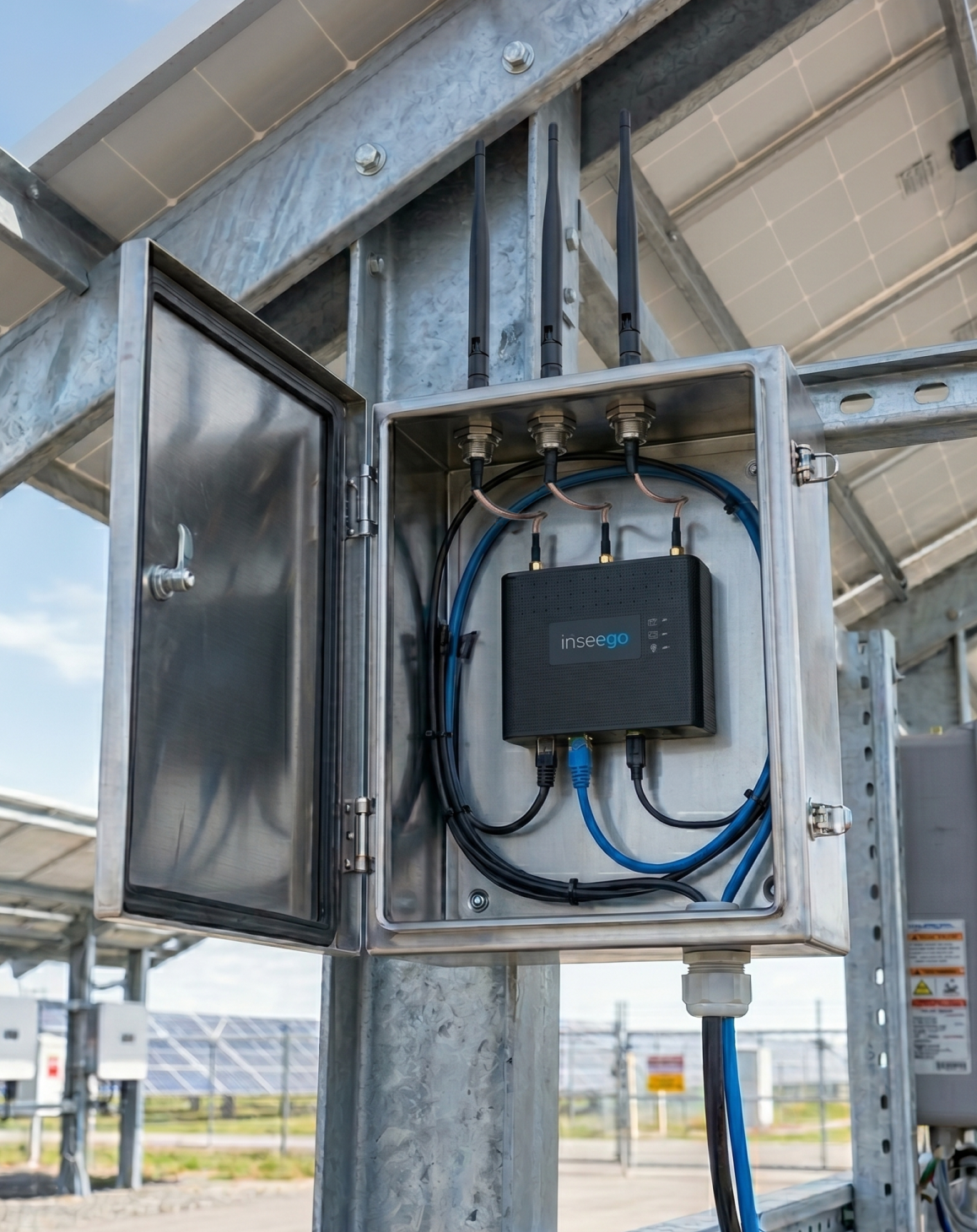
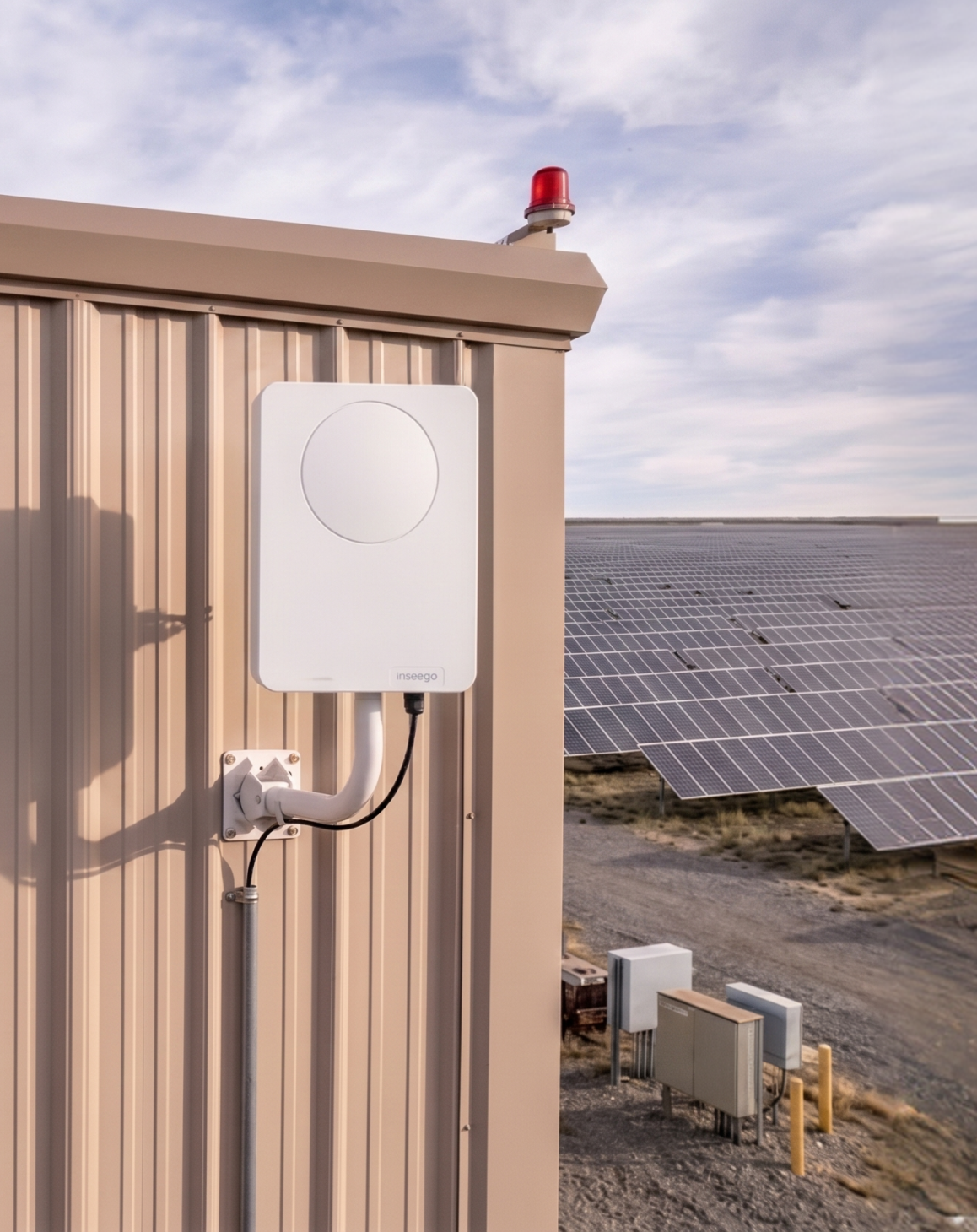
Renewable energy assets like wind farms and solar arrays are frequently located in isolated regions far away from traditional network infrastructure. The Inseego Wavemaker FW2000 uses high-gain directional antennas (up to 14 dBi) to capture stable 5G connectivity from distant base stations up to 20 km away. This provides the multi-gigabit broadband required to backhaul telemetry data from isolated generation sites back to the central utility network.

5G for the energy sector
Trusted by leading companies

Inseego understands the need for robust & reliable connectivity for the energy sector
The energy sector is at a pivotal moment as the global push for sustainability meets the technical demands of critical infrastructure modernization. Moving away from legacy LTE systems, the transition to 5G technology serves as a primary enabler for the next generation of energy systems. By deploying a wireless edge strategy with high-performance 5G connectivity and cloud-based network management, operators can leverage robust wireless networks to manage the increasingly complex ecosystem of renewable energy sources and decentralized energy grids.
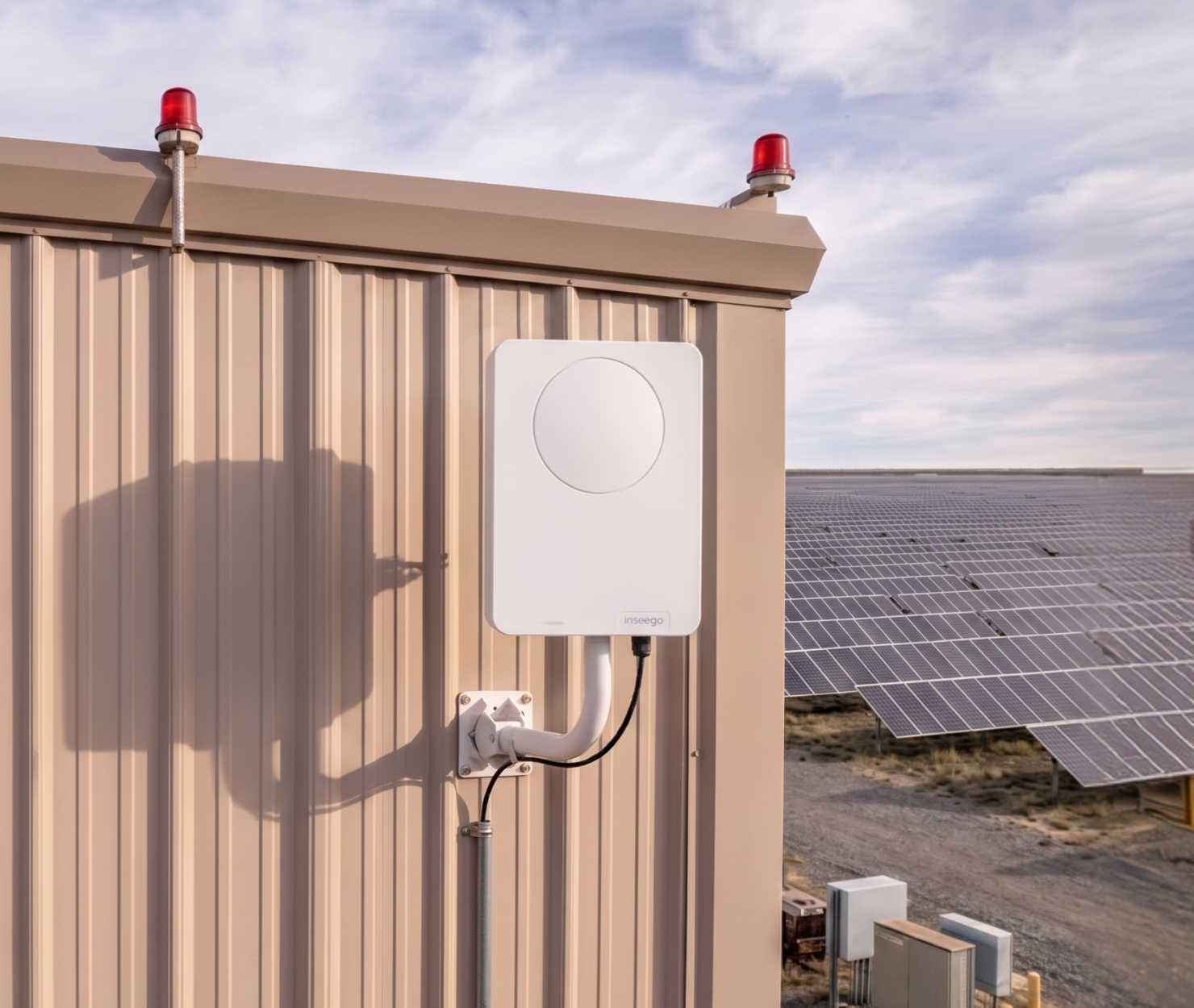
High-gain signal for remote energy plants with the FW2000 & FW3000 outdoor CPEs
Long-range directional signal capture for remote asset tracking
Multi-carrier dual-SIM failover for continuous remote generation monitoring
To protect remote power sites from single-carrier network dropouts, both outdoor CPEs feature dual-SIM slots with automated switching logic. If the primary service provider experiences an outage, the CPE instantly transfers the data pipeline to a backup mobile network. This persistent wireless connectivity ensures that automated grid alerts and energy storage telemetry metrics flow uninterrupted to prevent localized outages from cascading.
Reliable connectivity for real-time surveillance in harsh conditions
Utility infrastructure must maintain persistent performance through volatile weather fluctuations without structural failure. Engineered with a ruggedized, IP67-rated weather-proof enclosure, the FW series resists complete dust ingress and high-pressure water exposure. Featuring an integrated internal heating element alongside a wide operational temperature threshold (-22 °F to 158 °F), the hardware guarantees baseline link reliability in both freezing northern winters and extreme desert heatwaves.
Multi-carrier and WAN failover for continuous remote plant monitoring
To protect remote power sites from single-carrier network dropouts, both outdoor CPEs feature dual-SIM slots with automated switching logic. If the primary service provider experiences an outage, the CPE instantly transfers the data pipeline to a backup mobile network. This persistent wireless connectivity ensures that automated grid alerts and energy storage telemetry metrics flow uninterrupted to prevent localized outages from cascading.
Substation telemetry, failover protection & smart meter concentration with the FX4200 cellular router
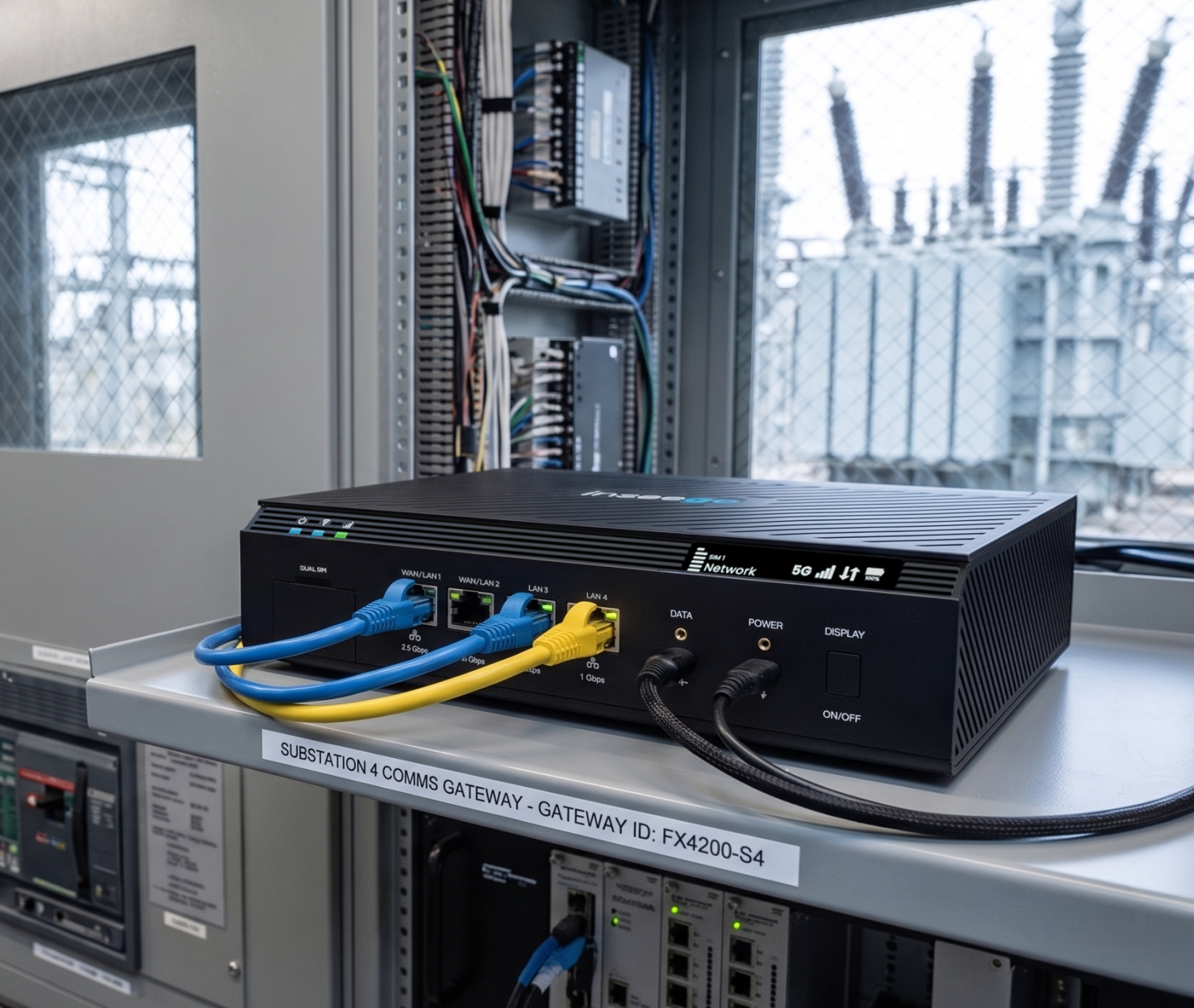
Dual-WAN automated failover for continuous grid uptime
To prevent disruptions to critical utility applications and avoid costly outages, the router provides automated WAN redundancy. If a primary wired connection fails, the hardware executes an immediate transition to a secure 5G network, protecting critical infrastructure from downtime. This persistent link keeps smart grids online to perform automated rerouting commands that isolate faults before they cascade.
Substation telemetry backhaul via multi-gigabit cellular routing
The FX4200 cellular router acts as a high-capacity primary gateway at substations, providing the reliable connectivity and bandwidth necessary for real-time monitoring of energy distribution and grid health. This allows utility providers to maintain constant visibility over power flow metrics, ensuring that fluctuating loads are balanced instantly across regional power grids.
High-capacity Wi-Fi 7 access point for dense local endpoint connection
Equipped with a high-performance Wi-Fi 7 radio, the cellular router functions as a local wireless access point that supports up to 256 simultaneously connected devices. This allows a massive density of nearby smart metering endpoints, asset trackers, and localized grid sensors to connect to a single router in a concentrated space, ensuring all field data cleanly reaches the 5G network without causing local signal congestion
Ruggedized field telemetry & critical infrastructure monitoring with the Skyus 160 gateway
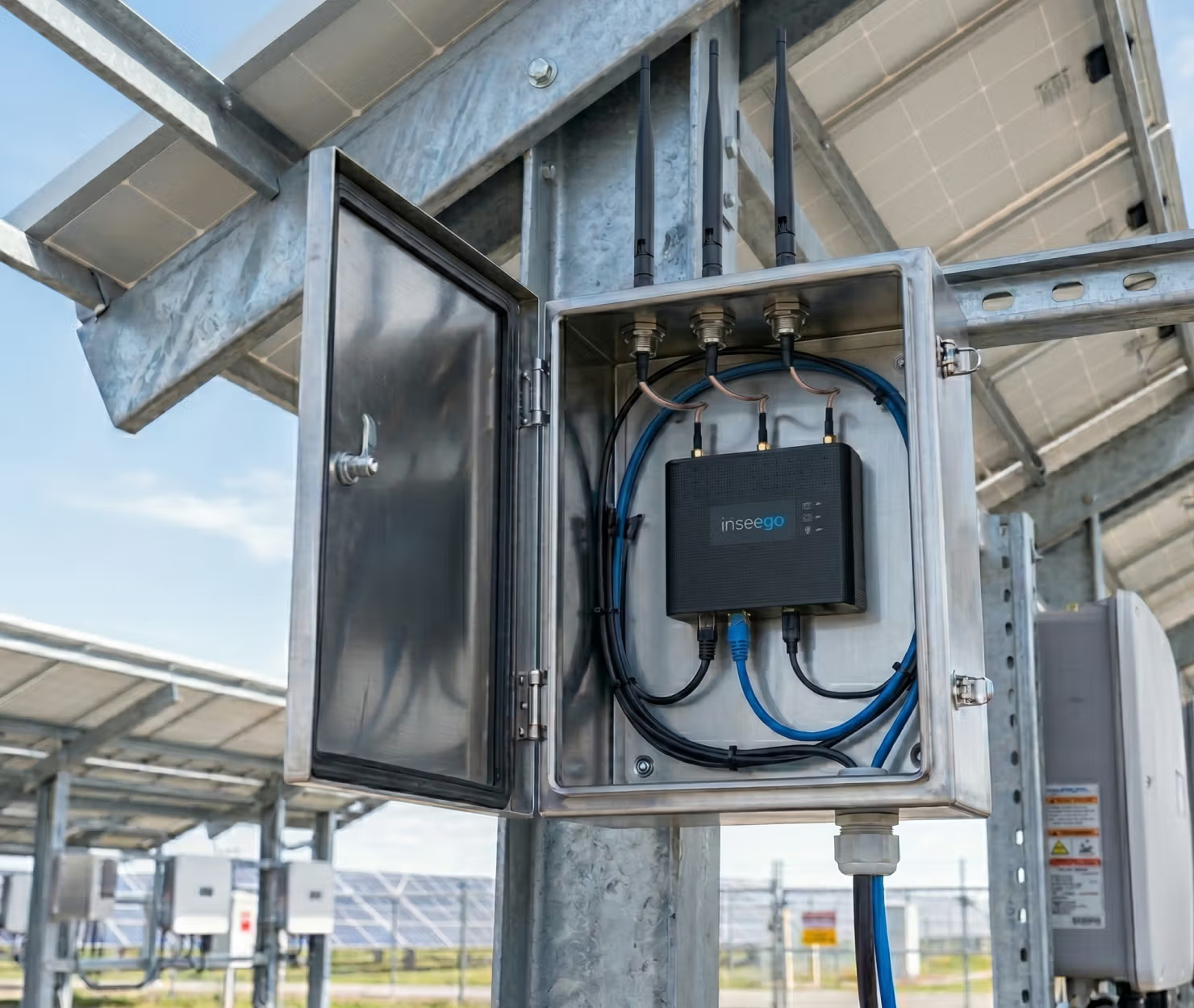
Compact, semi-rugged form factor for tight enclosure integration
Space inside outdoor electrical cabinets, pad-mounted switchgear, and localized junction boxes is tightly restricted. The gateway features a compact footprint with integrated mounting tabs, allowing it to easily slip into crowded hardware configurations. Operating seamlessly from -4 °F to 122 °F with versatile Power-over-Ethernet (PoE) options, it withstands the localized temperature swings common in unventilated field enclosures.
Continuous SCADA telemetry and PLC monitoring via Cat 6 LTE
Heavy-duty utility equipment like reclosers, voltage regulators, and programmable logic controllers (PLCs) require steady, continuous data rather than raw multi-gigabit speeds. The Skyus 160 functions as a dedicated industrial gateway, providing cost-effective Cat 6 LTE tracking and processing to feed operational metrics back to central SCADA systems without over-provisioning network resources.
Integrated 12-hour battery backup for uninterrupted grid visibility
During catastrophic storms or equipment failures that trigger localized power grid dropouts, monitoring devices frequently lose power and go dark right when data is needed most. Equipped with an internal 4400 mAh lithium-ion backup battery, the gateway maintains full operations for up to 12 hours after an outage. This ensures that critical diagnostic logs and alert telemetry continue streaming to help teams pinpoint the exact source of a physical fault.
Active aGNSS for precise asset tracking
Managing mobile generators, temporary substations, and high-value field hardware across expansive service areas requires absolute positional clarity. The gateway integrates an active aGNSS module (supporting GPS, GLONASS, and Galileo) to feed continuous, highly precise location coordinates back to central operations. This helps infrastructure managers verify field asset placement, prevent equipment drift, and secure high-value remote gear during emergency recovery operations.
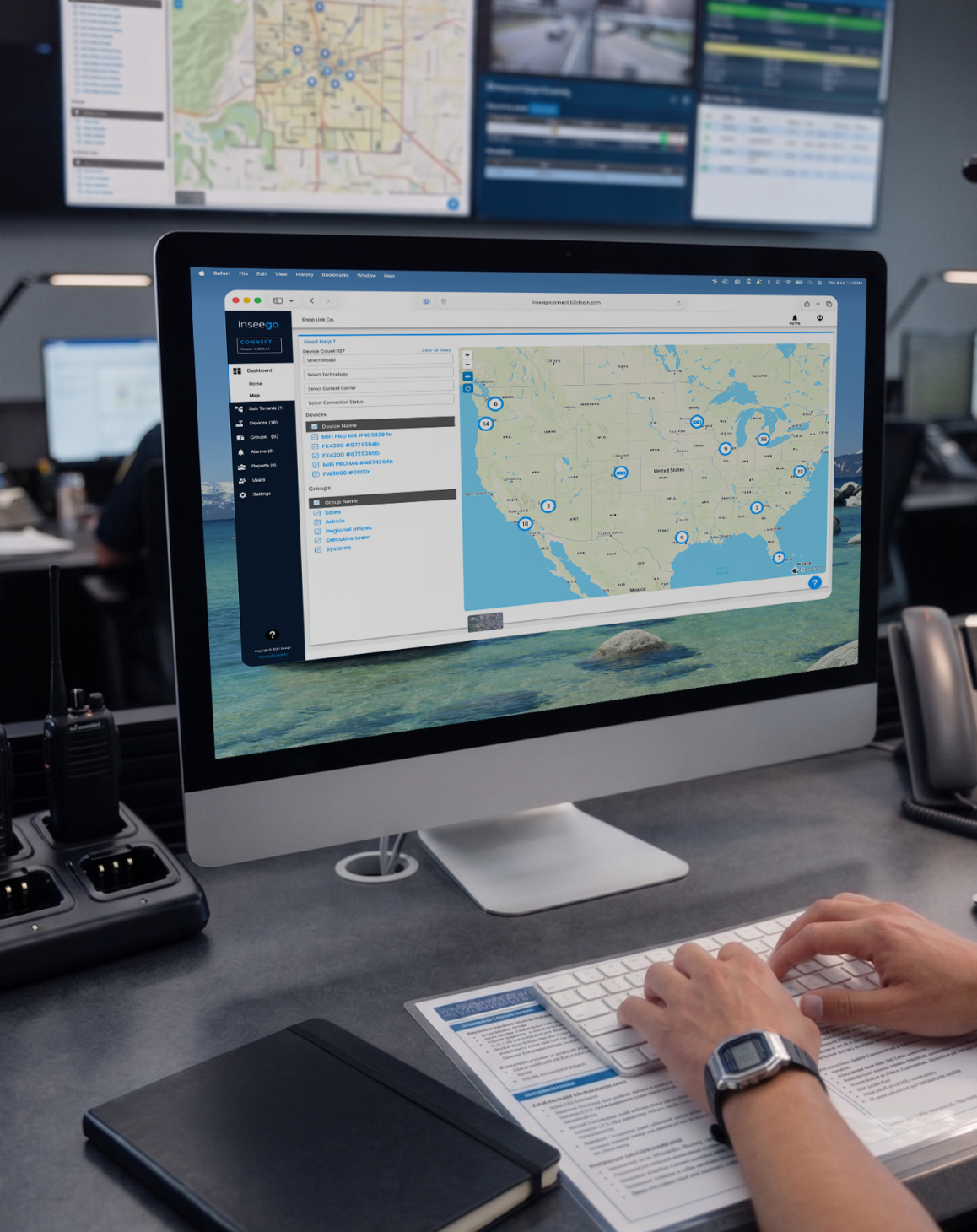
Zero-touch provisioning and secure network orchestration with Inseego Connect
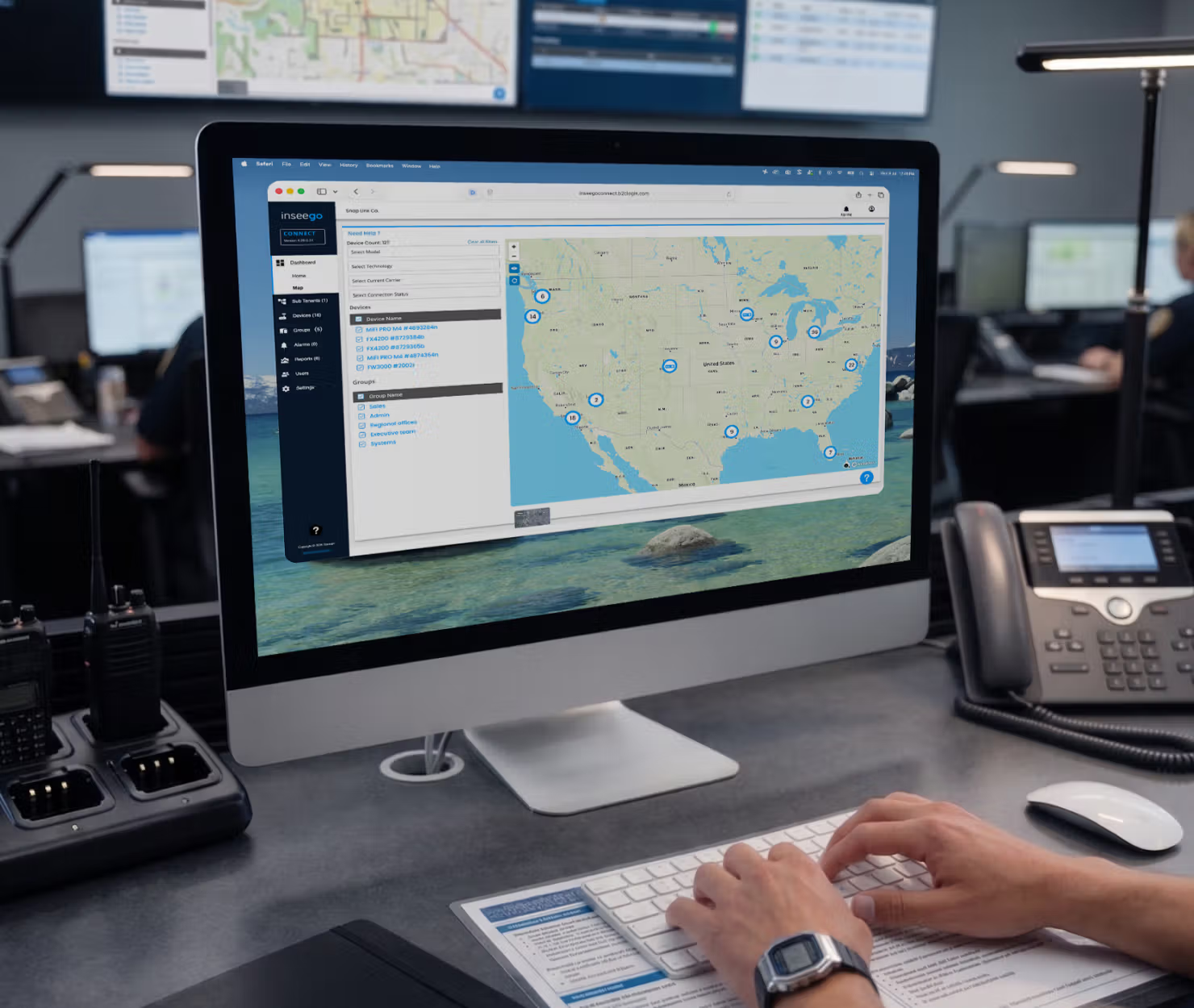
Centralized fleet diagnostics for proactive grid infrastructure visibility
Gives utility IT teams a single cloud-based dashboard to monitor the status of all edge hardware across expansive geographic footprints. Administrators can track real-time signal diagnostics, analyze data consumption trends, and monitor hardware health metrics to identify vulnerabilities and perform predictive maintenance before a communication link failure drops grid telemetry.
Bulk template scheduling for rapid multi-site utility rollout
Eliminates the need for manual, device-by-device setups during large-scale network modernizations. Network architects can build standardized security and network configurations in the cloud and push them simultaneously to thousands of deployed routers and gateways upon power-up, speeding up deployment timelines across vast energy grids without requiring specialized on-site IT technicians.
Remote compliance, cryptographic, and firmware updates
Inseego Connect allows IT teams to execute remote diagnostics, run advanced downstream troubleshooting, and push mandatory firmware updates simultaneously across hundreds of Inseego devices. This keeps the entire ecosystem protected against evolving cyber threats and ensures that hardware configurations remain strictly aligned with security policies like FIPS 140-3 encryption standards without manual, device-by-device intervention.
Geofencing and location intelligence for tactical asset tracking
Managing a widespread inventory of mobile gateways across decentralized distribution grids requires instant asset visibility. Inseego Connect aggregates the real-time data from integrated aGNSS modules across all active remote field hardware installations to ensure secure geofencing and unauthorized device movement protection.
Out-of-band management for absolute station and dispatch continuity
When a primary fixed gateway or station router experiences a critical software hang, typical remote access tools fail, threatening energy sector IoT tools. Inseego Connect provides a secure Out-of-Band Management path via the cellular connection, allowing network engineers to remotely reboot, troubleshoot, and reconfigure unresponsive hardware at critical stations to minimize downtime.
Secure "Enterprise Bubbles" for mobile workforces with MiFi PRO M4 mobile router
Enterprise-grade Wi-Fi 7 hotspot for mobile utility field crews
Field technicians performing on-site maintenance or line repairs need immediate, local internet access to pull up structural blueprints and grid diagnostics. The Inseego MiFi PRO M4 deploys an encrypted Wi-Fi 7 pipeline directly from a service vehicle or technician pack. Supporting up to 50 simultaneously connected devices, it ensures that field laptops, tablets, and testing tools can securely coordinate without local wireless bottlenecks.
Battery-less AC operation mode for permanent field enclosure deployment
Many grid tracking sites require continuous, 24/7 connectivity, but traditional mobile hotspots face thermal risks and battery degradation when plugged in indefinitely. The device includes a dedicated battery-preservation profile and supports full operation via direct AC or USB-C power with the physical battery completely removed. This unique capability enables utilities to use the hotspot as a permanent, low-profile wireless connectivity gateway inside remote equipment boxes or staging trailers without risk of hardware failure.
Gigabit RJ45 Ethernet porting for legacy physical tool integration
Field engineers frequently interact with legacy diagnostic hardware, heavy-duty network appliances, and testing tools that lack wireless radios. Built with a dedicated 1 Gbps RJ45 Ethernet port alongside its wireless bands, the hotspot bridges the gap between field-grade physical assets and the 5G network. This allows engineers to plug older physical equipment directly into a high-speed, secure mobile link to offload data instantly.
The Inseego tools that let you focus on business
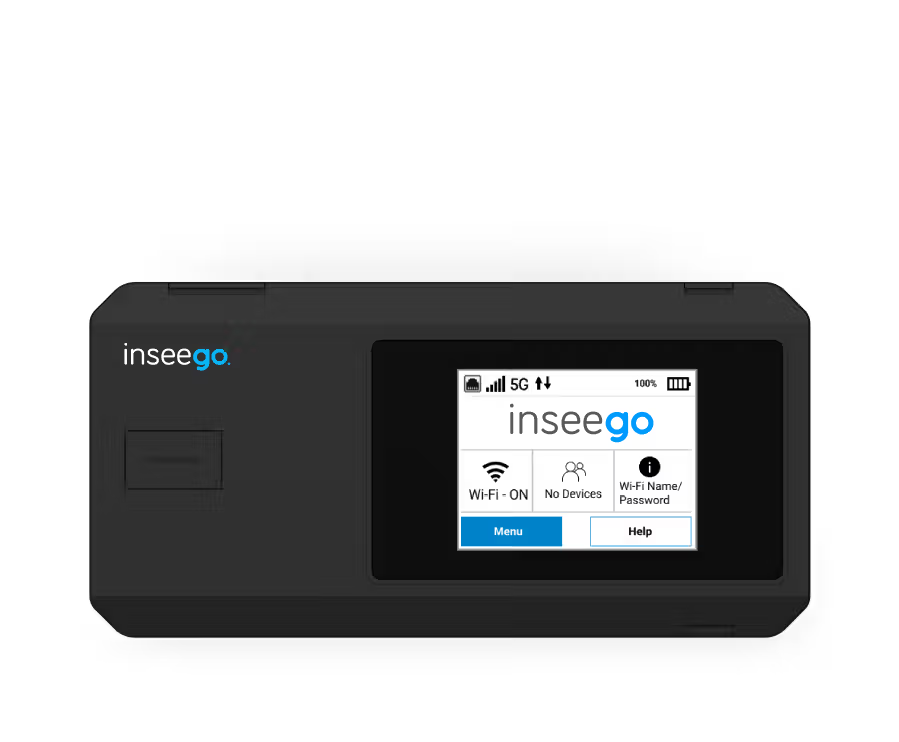
Inseego MiFi™ PRO M4
Secure while stationary. Secure while mobile. Secure throughout the edge.
See device details
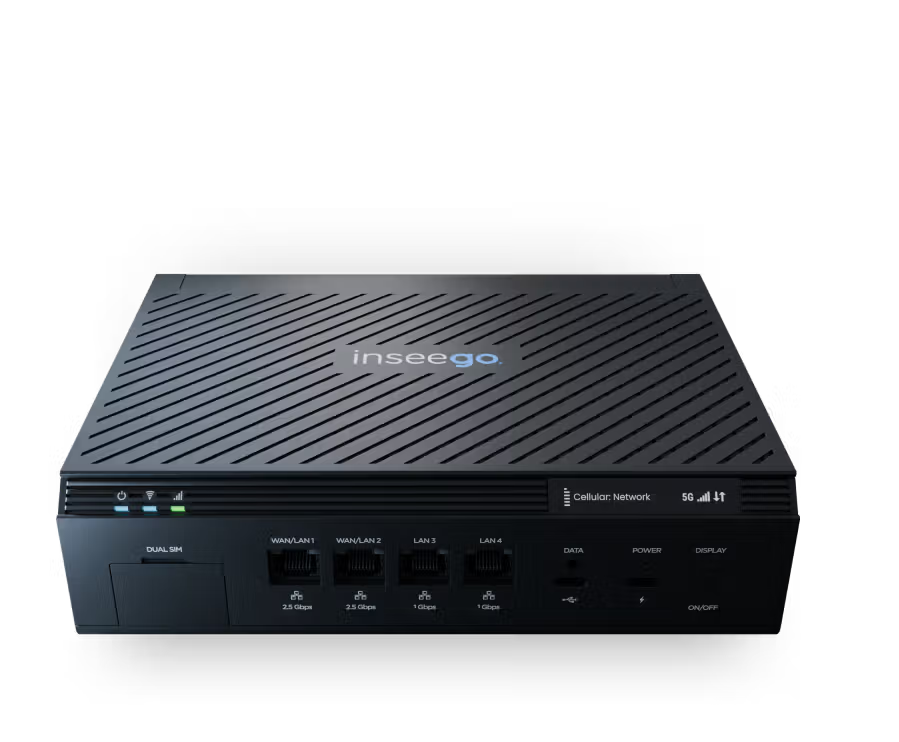
Inseego Wavemaker™ FX4200
Powerful 5G and failover that's simple to deploy, with all the cloud management features your network needs.
See device details
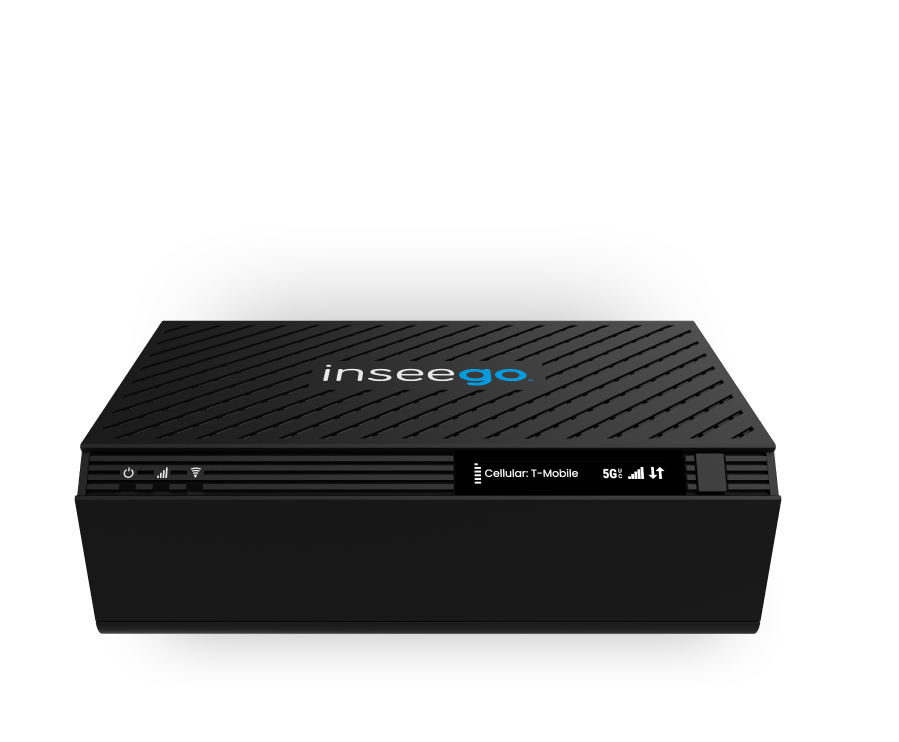
Inseego Wavemaker™ FX4100
Future-proof your business network with advanced 5G capabilities & Wi-Fi 7
See product details
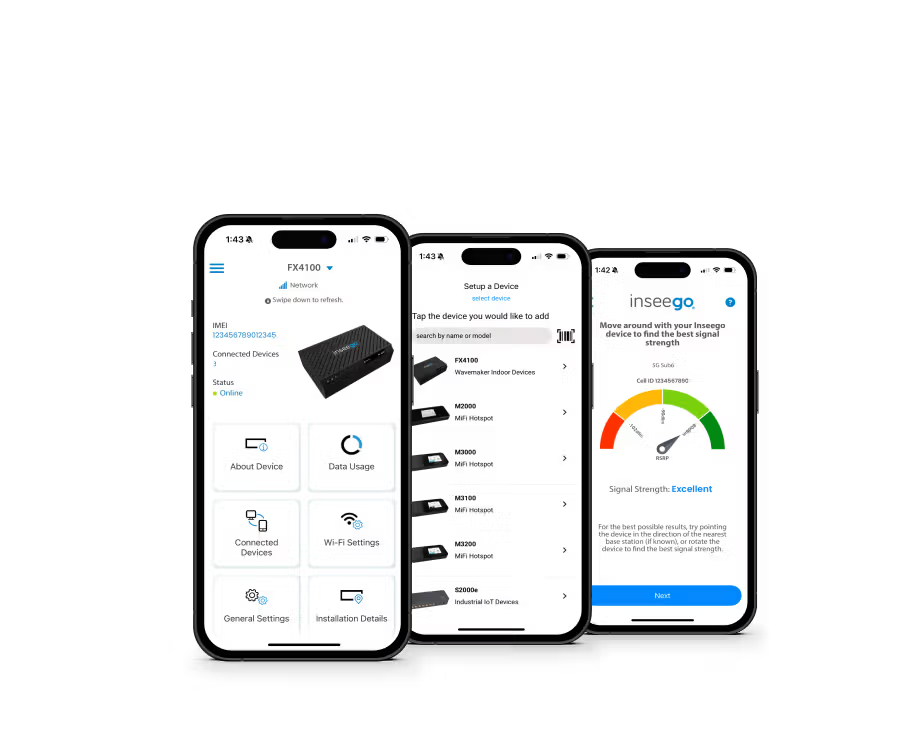
Inseego Mobile™ app
Simplify device setup and remote management capabilities with our mobile app.
See product details
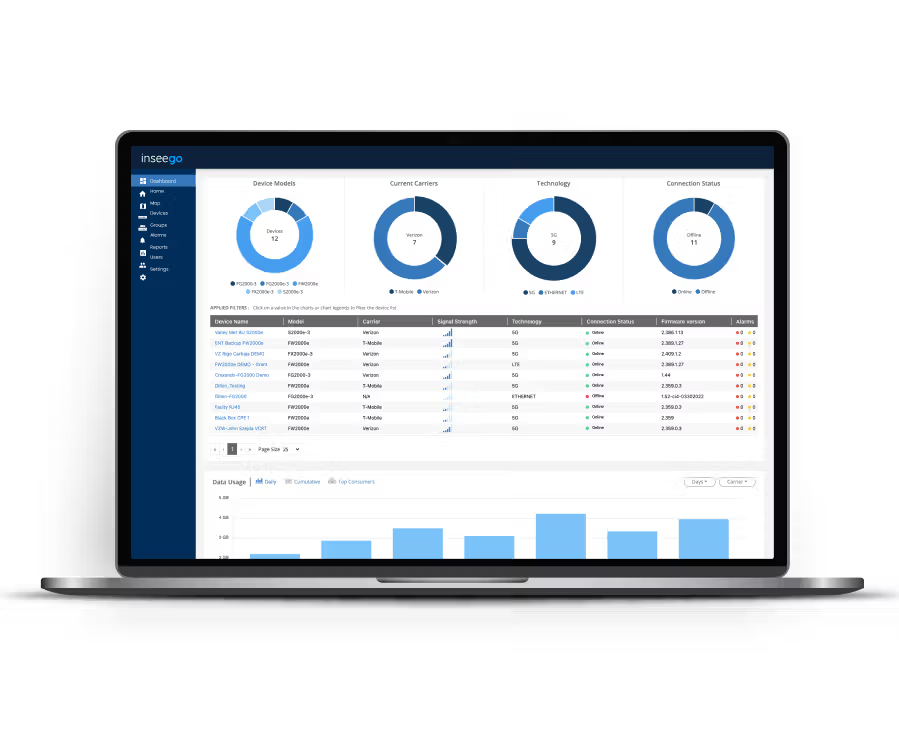
Inseego Connect™
A centralized cloud platform designed to manage the entire enterprise wireless edge with the Inseego portfolio
See product details
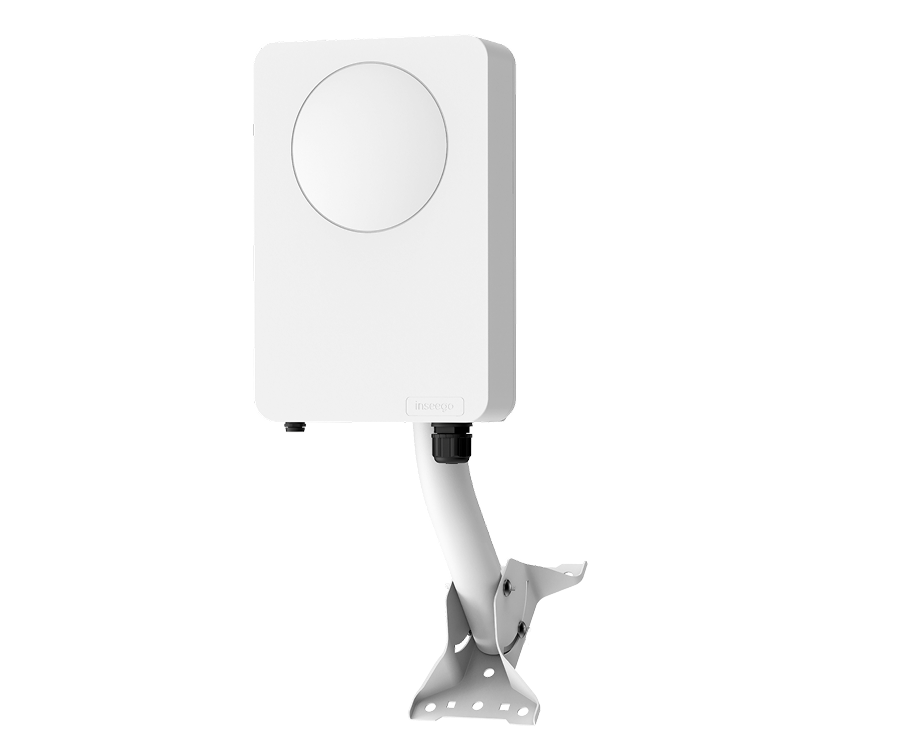
Inseego Wavemaker™ 5G Outdoor CPE FW3000
Rugged, high-gain outdoor 5G with easy plug-and-play setup.
See product details
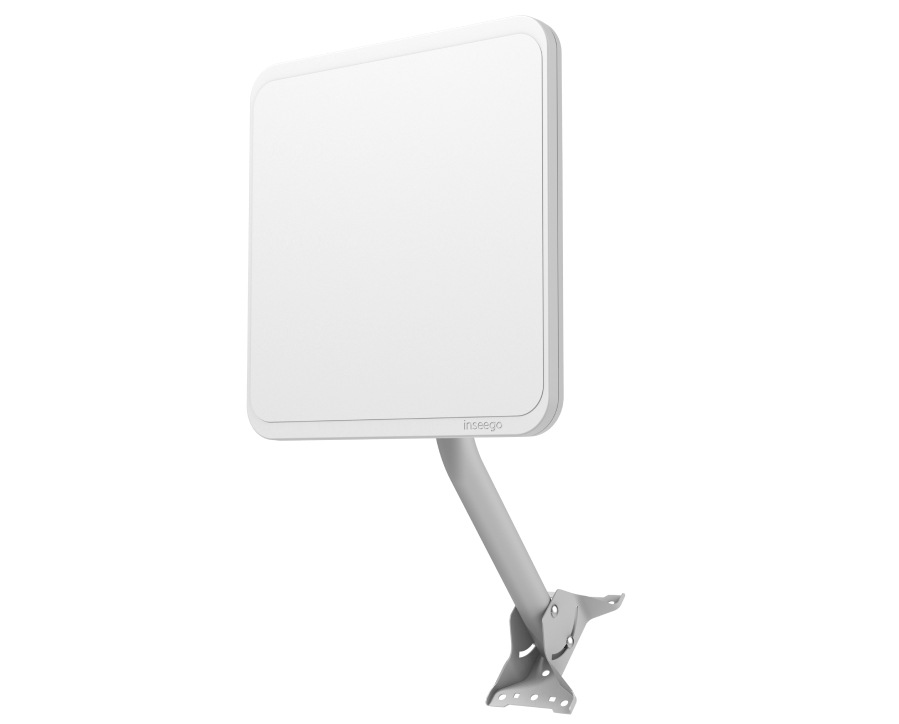
Inseego Wavemaker™ 5G Outdoor CPE FW2000
Long-range. Rugged. Reliable 5G antenna.
See product details
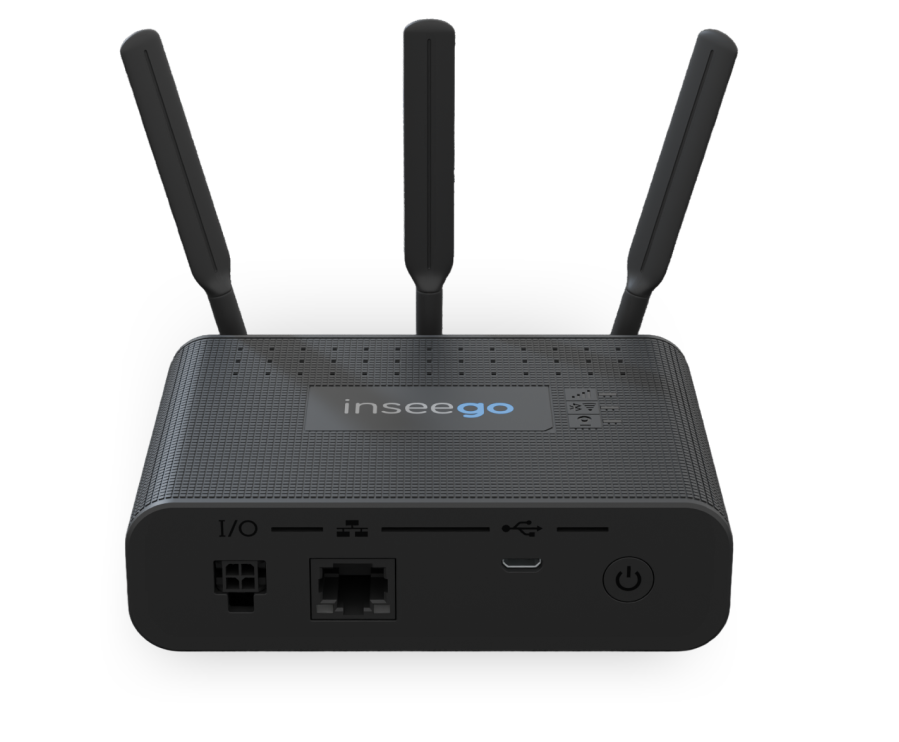
Inseego Skyus 160 IoT gateway
All-in-one solution for versatile, reliable, and secure IoT connectivity.
See product details
Global wireless edge connectivity

Simple to deploy, simple to operate
Guided self-installation tools and centralized cloud management eliminate operational friction, making broadband effortless to deploy and maintain.
Learn more
Comprehensive wireless broadband portfolio
A unified lineup of routers, gateways, receivers, adapters, and hotspots allows providers to serve every customer segment through a single trusted platform.
Learn more
Performance, scale, and global networks
Advanced engineering delivers superior signal quality and reliable connectivity designed to scale to global networks and as technologies evolve.
Learn more
Platform for carrier operations
Subscriber-lifecycle management, open APIs, and cloud orchestration simplify operations beyond hardware, helping providers scale enterprise services efficiently.
Learn more
Strategic wireless partner
Over 25 years of mobile broadband experience drives collaborative innovation, helping providers navigate network evolution and long-term growth.
Learn moreFrequently asked questions
How do high-performance cellular networks compare to traditional wireline and other wireless options for smart grid deployment?
Traditional fiber and copper deployments offer high reliability but are cost-prohibitive to trench across expansive power grids, while legacy wireless platforms lack the necessary throughput and speed. Modern high-speed cellular routing bridges this gap by delivering the deployment flexibility of wireless alongside ultra-reliable, sub-millisecond communication latencies. This provides the real-time data pipe required for near-instantaneous automated decision-making, allowing communication networks to isolate a physical line fault and execute automated rerouting commands within milliseconds to significantly reduce the duration and scope of grid outages.
What role does high-bandwidth edge hardware play in integrating variable renewable energy sources?
Power generation from renewable energy like wind and solar is inherently volatile. Robust, high-gain edge routing devices act as the primary enabler for balancing this volatility by streaming continuous, real-time data from remote weather stations, generation sensors, and energy storage facilities. This allows energy providers to dynamically optimize grid load balancing and match active distribution to shifting production levels, maintaining baseline stability.
How does private cellular infrastructure enhance the cybersecurity of critical energy assets?
For many utility service providers, deploying dedicated private 5G or LTE architectures is preferred over utilizing public mobile networks. This creates a physically and logically isolated network ecosystem for sensitive power systems. By utilizing hardware-level network slicing, an enterprise can ensure that critical telemetry and automated command traffic are completely cordoned off from public internet data, drastically reducing the attack surface for cyber threats against power plants.
How do specialized outdoor CPEs maintain connectivity in remote generation environments?
Remote wind farms, solar fields, and storage banks often face extreme weather barriers and sit far outside the reach of standard fixed broadband. Hardened hardware like the Inseego Wavemaker FW2000 5G Outdoor CPE is engineered with high-gain directional antennas to pull in strong signals from distant cell towers. This provides the reliable bandwidth necessary for predictive maintenance and asset monitoring where traditional wireline trenching is cost-prohibitive.
Resources & news
Find out what’s new in the 5G space

Case study
Reliable POTS replacement for critical infrastructure in senior living communities with the Inseego FX3110 indoor router
Read more

News
Inseego to showcase next-generation connectivity solutions at the Global prpl Summit and Network X 2026 in Vienna
Read more

Blog
What is CMMC 2.0 and why does it matter for federal networks?
Read more