Unlock lightning-fast 5G internet almost anywhere

Return to blog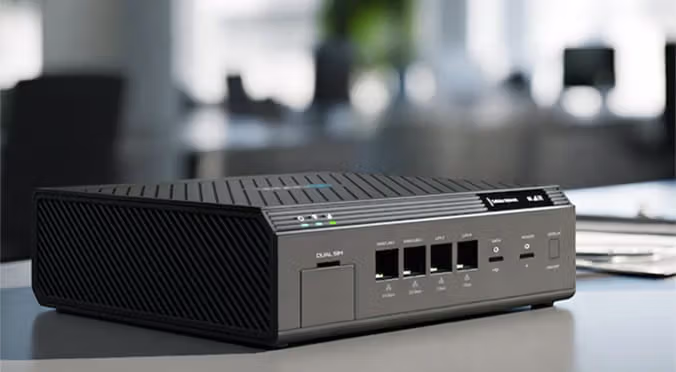
5G
Three reasons why 5G Advanced and Wi-Fi 7 are the new standard for enterprise connectivity
Updated on October 1, 2026
The combination of 5G Advanced (IEEE 802.11be) and Wi-Fi 7 solves the "bottleneck" problem that has plagued wireless networking for years. While previous generations of Wi-Fi technology, such as Wi-Fi 6E, introduced the 6 GHz band, Wi-Fi 7 represents a massive leap in extremely high throughput (EHT) and better usage of the 6 GHz band.
When the wide-area pipe (WAN) and the local-area network (LAN) operate at the same multi-gigabit speeds with synchronized protocols, wireless finally becomes a viable primary connection for mission-critical work. This next generation of wireless access ensures that data rates and latency are no longer hurdles for the user experience.
1. Eliminating the bottleneck from 5G to Wi-Fi
The problem:
Connected devices, like real-time security cameras or automated inventory IoT robots, require massive throughput. If the 5G connection brings in multiple Gbps but the local wi-fi networks can't distribute it fast enough, devices become slow and unresponsive.
The solution:
- Widening the capacity: Wi-Fi 7 utilizes 320 MHz channels, effectively doubling the channel width compared to Wi-Fi 6. This massive channel bandwidth ensures 5G data has a wide-open path to reach all Wi-Fi 7 devices.
- Eliminating lag stuttering: Wi-Fi 7 uses 4096-QAM (Quadrature Amplitude Modulation), which packs 20% more data into every signal compared to the 1024-QAM found in Wi-Fi 6. By leveraging the 6 GHz band and advanced modulation, the result is lower latency and the smooth, high-definition stream that AI models need for split-second decisions.
Unlock lightning-fast 5G internet almost anywhere
2. Managing high-density environments
The problem:
In a busy office or warehouse, dozens of devices (phones, scanners, laptops) all fight for the same Wi-Fi signal. This leads to "congestion," where critical business tools get stuck behind someone else's guest traffic or background updates.
The solution:
- Bypassing interference: With Multi-Link Operation (MLO), Wi-Fi 7 doesn't just pick one of the frequency bands; it uses the 2.4, 5, and 6 GHz bands simultaneously. Through aggregation, if one band is crowded, MLO instantly hops data to a clear one to optimize the connection.
- Network slicing: 5G Advanced uses Network Slicing to reserve a "virtual lane" for the most important traffic. Because Wi-Fi 7 understands these 5G tags, that priority is maintained all the way to the device. Point-of-Sale (POS) terminals stays fast, even if the guest Wi-Fi is completely full.
- Resource Units (RU) and OFDMA: Building on Orthogonal Frequency Division Multiple Access (OFDMA) and MU-MIMO from Wi-Fi 6, the new wi-fi standards allow for more efficient preamble puncturing. This means even if part of a channel is busy, the rest of the bandwidth can still be used, maintaining low latency for Point-of-Sale (POS) terminals.
3. Powerful speeds, reliability, and easier deployment
The problem:
Fiber installs take months, cost thousands, and offer zero mobility. Historically, wireless was avoided for primary use due to performance and failover lag not being up to par with cable/fiber.
The solution:
- Gigabit speeds from wireless: 5G Advanced uses Uplink Carrier Aggregation (UL-CA) to close the speed gap between downloads and uploads. This allows for fiber-like performance for data-heavy outgoing tasks, such as 4K surveillance streaming or large file uploads.
- Eliminating the wait for connectivity: Organizations can achieve fiber-grade stability on "Day 1" instead of waiting 6–12 months for a physical cable trench.
- Instant failover: Wi-Fi 7 routers and 5G Advanced systems can run in an "always-on" state. Because the cellular and Wi-Fi links operate on the same high-speed wavelength, the failover is almost instant, providing high bandwidth reliability that matches cable or fiber.
How Inseego implements both 5G Advanced and Wi-Fi 7
We offer multiple products in our portfolio engineered to manage the transition from 5G Advanced to a Wi-Fi 7 access point through a unified platform. Our routers provide these enhancements to significantly improve use cases across the enterprise.
Wavemaker FX4200 cellular router
The FX4200 is a high-performance cellular router designed to bring multi-gigabit 5G Advanced connectivity to fixed locations like branch offices, retail storefronts, and industrial sites. It serves as an alternative to traditional wired broadband, offering fiber-like speeds with the flexibility of a wireless connection.
- 5G Advanced processing: Built to handle the massive bandwidth of 3GPP Release 18, it ensures the wide-area signal is translated into a localized Wi-Fi 7 environment without throughput loss.
- Integrated site survey mode: Includes an internal 5050 mAh battery and signal display, allowing installers to find the peak 5G reception point before permanent mounting.
- Dual-SIM support: Supports two carriers for cellular failover between them in case one of the carrier cellular connection drops.
- 2.5 GbE architecture: Features dual 2.5 Gbps Ethernet ports to maintain multi-gigabit speeds across wired office infrastructure.
- Hardware security: Built-in WPA3, VPN orchestration, and FIPS 140-3 compliance to keep enterprise-grade security over the network.
MiFi PRO M4 mobile router
The MiFi PRO M4 is an enterprise-grade mobile router that creates a secure, high-speed "enterprise bubble" for teams in the field. It combines the portability of a handheld device with the robust throughput and security features of a stationary router.
- Uplink aggregation (UL-CA): Specifically optimized for 5G Advanced to ensure fast uploads of 8K video or large BIM files from the field, overcoming the traditional wireless upload bottleneck.
- Battery-free mode: Can run on AC power with the battery removed to eliminate thermal risks and "battery bloat" in 24/7 kiosk or remote office deployments.
- Device capacity: Supports up to 50 concurrent users on a single Wi-Fi 7 enterprise bubble, significantly increasing capacity for high-density team deployments.
- Professional encryption: Features hardened security protocols with FIPS 140-3, built-in WPA3, VPN orchestration, and secure boot processes suitable for high-security enterprise use.
Inseego Connect: Cloud-based network management
Inseego Connect is a unified cloud platform that gives IT teams the ability to manage 5G Advanced and Wi-Fi 7 as a single, coordinated system. It acts as the intelligent brain of the operation, ensuring that the high-performance capabilities of the hardware are utilized effectively across a global fleet.
- Zero-Touch Provisioning (ZTP): Deploy 5G Advanced and Wi-Fi 7 across thousands of sites without sending a technician. Businesses can create configuration templates that automatically push complex settings, like Multi-Link Operation (MLO) for Wi-Fi 7 or specific APN configurations, the moment a device is powered on for the first time.
- Real-time performance visibility: The platform provides deep telemetry into how the 5G Advanced signal is performing. Businesses can monitor SINR (Signal to Interference plus Noise Ratio) and RSRP in real-time, allowing users to see exactly how the cellular connection supports the Wi-Fi 7 traffic at each location.
- Out-of-Band Management (OOBM): Use Inseego 5G devices as a secure "back door" to the local network. If a primary fiber or cable line fails, IT teams can tunnel through the 5G link via Inseego Connect to remotely access, diagnose, and reboot other local hardware like switches or security appliances.
- Multi-network wide security & policy enforcement: Instantly push firmware updates and security patches to every device in all business networks. This ensures that every node on the wireless edge is running the latest Inseego 5G Advanced optimizations and Wi-Fi 7 encryption standards.
- Historical analytics & speed testing: Run remote speed tests and view historical performance data to identify trends. This helps IT teams determine if a localized slowdown is due to cellular congestion or a local Wi-Fi 7 configuration issue before it impacts the end user.
Ensure business networks are ready for the new enterprise standards with Wi-Fi 7 and 5G Advanced.
Talk to our experts!
Set your customers or business up with the fastest, most secure, easiest, most reliable fixed wireless solutions.